
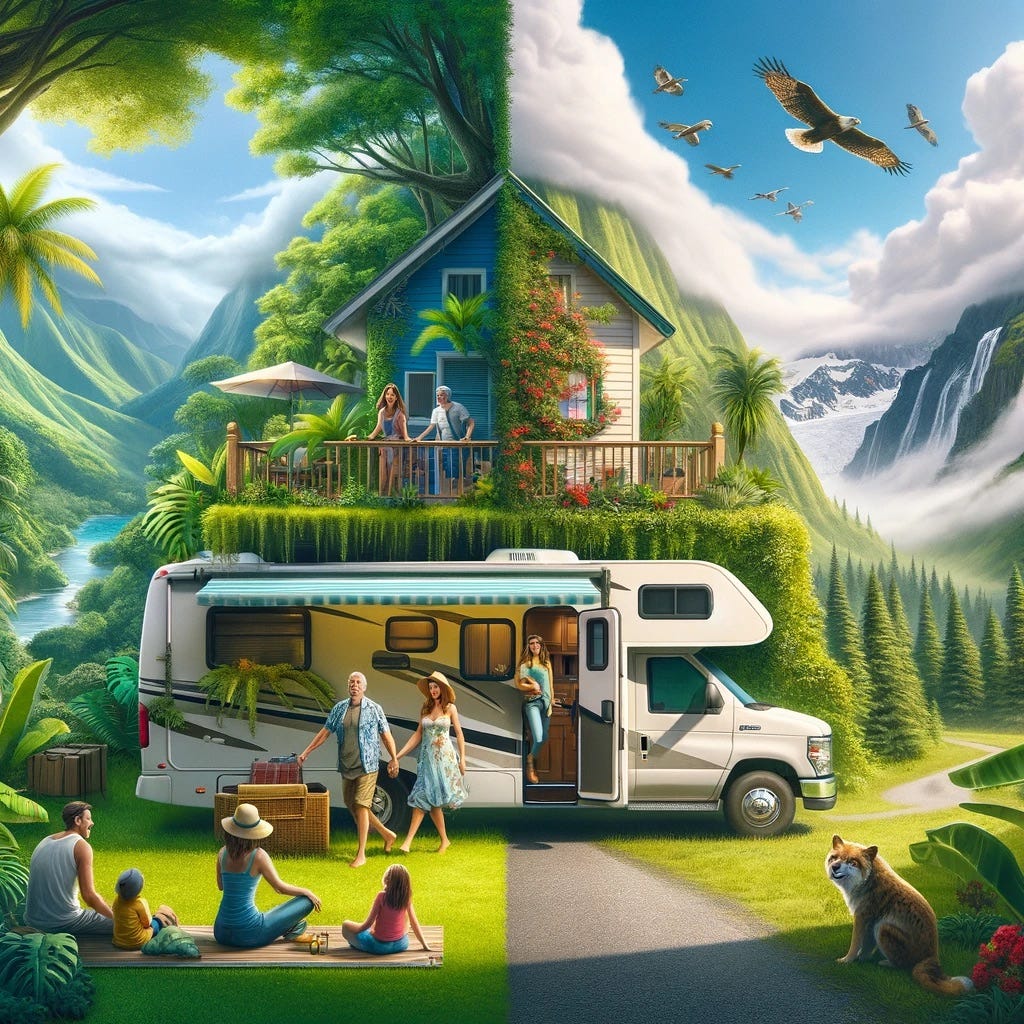
In 2021, inspired by friends who had relocated to Costa Rica with their young children, we felt a compelling urge to step away from our usual routine and immerse ourselves in a radically different lifestyle. The allure of such a dramatic change was irresistible, prompting us to take the plunge.
I bought our flights and arranged a month-long rental in Costa Rica. The moment I confirmed the purchase of our seven plane tickets, a wave of nausea hit me. Doubts flooded my mind—was it really wise to take our entire family abroad for such an extended period? Yet, this leap is driven by my desire for a new experience, a test of living differently. And, in many respects, this experiment proved to be a success.
Navigating the long travel to Costa Rica was just the beginning. Once we arrived, we quickly fell in love with the country's unique culture and the relaxed pace of life. The gravel roads forced us to drive slowly, which turned out to be a blessing. Slowing down opened up the opportunity to truly take in our surroundings and enjoy the journey, unhurried. This shift to a slower pace opened my eyes to the hidden costs of what I had appreciated in American efficiency—clear straight superhighways, ubiquity of huge stores, and the availability of cheap food.
We noticed that food was pricier in Costa Rica. Initially, I was surprised and a bit offended, but I soon allowed it to change my perspective. Maybe the lower cost of food back home is largely due to compromises in the care for animals and the environment. This realization led me to question my assumption: perhaps food ought to be more expensive if it accounts for the wellbeing of our planet and its inhabitants. This experience challenged my perceptions and values outside of efficiency and the bottom line, especially regarding consumption and environmental stewardship.
Costa Rica was a period of significant growth and an extraordinary opportunity for family bonding. Days were simple yet profoundly satisfying—visiting the beach morning, noon, and night and simply being together. I worked remotely for two weeks without my employer being any the wiser to me having moved south 1200 miles. The entire experience was nothing short of amazing.
Our time in Costa Rica deepened my understanding of myself and how I desired to live. Back in Tennessee we had originally chosen our home in West Knoxville for its school zone, proximity to church and to school. However, our perspectives started to shift when Gabriel, at 9, expressed a desire to be homeschooled. He felt that public school involved too much idle time, that it was too slow, and too much sitting. Given his aptitude for learning the request made sense, though it meant a significant adjustment for Meggan.
Despite the high quality of public schools available to us, I started to see it in a new light—as a reflection of our civilization's propaganda. It seemed designed to make children conform, stay busy (regardless of whether meaningful learning was happening), and constantly engage in competitive career ambitions to help further our civilization. This was far from the learning experience or even philosophy I was envisioning for my children.
There is something I haven’t mentioned along the way. For more than five years, we have sent our kids to an alternative school, Forest School. This form of education allows children to direct their own learning journeys, fostering a love for the outdoors and facilitating play with other children. It is a beautiful blend of nurturing curiosity and encouraging learning. Witnessing how this approach opened our children up to a deeper appreciation of nature was both amazing and affirming. This significantly impacted our understanding of how we could generate alternative learning experiences for our kids. And we’ve seen the difference: a knowing and love for the woods and nature has been nurtured in a deep enduring way. They are open to the earth and loving of living beings, not as preoccupied with sports, competitive games or capitalist achievements. Priceless for me.
We still had an itch to experiment with alternative lifestyles, to see if breaking out of the urban experience had momentum. Inspired by friends who had embarked on an RV journey across the US with their five children, including their own twins during COVID, we found ourselves excited with the idea of doing something similar. However, the thought of navigating such a trip with our toddler twins at the time seemed daunting. Eventually, as time passed, we felt ready to seize our own adventure.
I took the first step by flying to Des Moines, Idaho, where I purchased a 37-foot RV, and drove it the 12-hour journey back home. We decided to move out of our house, renting it to another family, and spend the summer of 2023 on the road. I was confident in my ability to set up the necessary connections to work remotely while traveling. Meggan followed in our Honda van, and together, we embarked on this new chapter. One quick antidote: the adventure began with an eventful first night at a rest area. I was jolted awake at 3 a.m. by the RV rocking gently. I stumbled out of bed to investigate only to have our RV struck, causing a startling lurch. Outside, I found a semi attempting to pull out, its nose pressed into the rear of our bus. Fortunately, it only hit the tow line, sparing us any real damage. Quite the introduction to life on the road.
At the end of May, we moved out of our home and drove two hours to my in-laws' place to finalize our preparations. Our plan was to tour the northeast United States, an area I had never visited but was eager to explore. It promised to be an adventure, and indeed, it was.
The journey on the road was filled with the expected and unexpected alike. Living on the road was an amazingly energy infusing adventure. RV adventuring kept us awake and aware to the little gifts and moments along the way, opening me to new perspectives and places, bonding our family together in a special, deeply valuable way. Our Honda encountered numerous mechanical issues. It also seemed that at every stop, the RV demanded some minor repair—a reminder of the complexities of moving a house on wheels.
We made a beeline for Maine to rendezvous with our RV friends, then journeyed down the coast, with New Hampshire, Cape Cod, and Maine standing out as memorable highlights. Living nomadically was thrilling.
However, this lifestyle brought its own set of challenges. The constant uncertainty of where we'd stay next, coupled with the need to ensure our children's safety, weighed heavier than I anticipated. Adapting to life in an RV, surrounded by the sounds and proximity of other campers, was a significant adjustment from the quiet of a traditional home. Maneuvering such a large vehicle required intense concentration, limiting my drive time to five or six hours. The reality of spending nights in Cracker Barrel parking lots or being packed tightly into industrial-sized campgrounds was a bit removed from what I had anticipated. But the experience fed my reflections on the critique of modern life.
I was particularly struck by the transformation of modern camping culture. Almost every camper seemed to have a golf cart for short trips to the pool or campsite activities. Televisions inside and outside the RVs and radios playing up until the designated quiet hours painted a very different picture of camping than I remembered. Popular campgrounds are turned into mini resorts with mini golf, laser tag, arcade, basketball courts, playgrounds, swimming pools, and other forms of entertainment. The question lingered in my mind: when did camping and the original intent of recreation in nature become this? Was this a mirror of our cultural degradation in other ways?
Living on the road coincided with a spiritual realization, opening me up to insights I had only begun to explore. Embracing the existence of other spiritual realms from my interaction with plant allies reignited my curiosity about my Christian origins. I wondered, what insights could my own tradition offer that I had previously overlooked?
I stumbled upon the works of Elaine Pagels, particularly her studies on the Gnostic gospels discovered in the mid-20th century in the Middle East. Pagels sheds light on an alternative Christian tradition, one that was nearly extinguished by mainstream Christianity. The Gnostic perspective offered a more mystical, contemplative approach, portraying Christ as an inner guide rather than an external figure to be obeyed and worshiped. This view of Christ as a companion in the journey toward self-discovery was seen as a direct challenge to the orthodox traditions early on. These orthodox traditions eventually turned into Catholicism, Protestantism, and Evangelicalism, which emphasize external worship and adherence to structured authority.
The Gnostics, focusing on personal and profound experiences with the divine, posed a question to the orthodoxy: How could individuals connect with the divine without the need for external authority and structures? Because they did not systematize or widely propagate their beliefs, but instead cherished a personal relationship with a Christ consciousness, their practices were labeled heresy and suppressed. And eventually snuffed out.
Yet, I was fascinated to discover that the essence of Gnosticism appears to be resurfacing. Practices such as contemplation, meditation, and seeking a direct experience with Christ are finding their way back into spiritual conversations, suggesting a revival of these ancient teachings. This realization opened a new chapter in my spiritual exploration, connecting me back to the roots of Christianity in a way I had never anticipated.
Concurrently I discovered Charles Eisenstein's works, "The More Beautiful World Our Hearts Know Is Possible" introduced me to a critique of the prevailing Western narrative of progress. Eisenstein, a modern cultural philosopher, challenges the notion that we have made significant advancements, suggesting instead that our so-called progress is largely confined to technological conveniences and medical interventions for problems we scarcely understand. Our technological utopian dreams are an addiction we are all hooked on. An addiction with increasing sacrifices of the earth and of our intuitive inner truth to achieve diminishing returns (read the book and let me know what you get - he says a lot!). His perspective resonated with me, highlighting a trade-off between our connection to the earth and the pursuit of gadget filled convenience. He is advocating an interbeing way of relating to others and the earth, as opposed to the prevailing mindset of separation and disconnectedness.
My exploration continued. Influenced by the psychology and psychedelic literature, I felt drawn towards understanding the soul's role in our lives. If the spirit represents purity, heavenly perfection, and expansiveness, then the soul embodies the earthy, dark, and deeply felt connections. This distinction fueled my desire to delve deeper into the experience of the soul, guided not by traditional meditation or academic study, but by immersion in nature and solitude.
Authors like Bill Plotkin and David Abram furthered this awakening, showing me how I had prioritized spiritual growth at the expense of nurturing my soul. Their writings made me realize that while the spirit and soul are intertwined, they offer distinctly different pathways to understanding my purpose, my place in the world. This insight has been pivotal, pushing me to seek a balance that honors both the ethereal aspects of my being and the profound, grounded connections that the soul facilitates.
It seems our connection to the soul is waning as we increasingly isolate ourselves from the earth through cement and concrete landscapes, novel ways to transport ourselves without touching the ground, and insulating ourselves in climate controlled working and living spaces. The opportunity to learn from nature—rather than merely about nature—is slipping away. How often do you actually stand with your feet in the grass? How well does our urbanized society facilitate a genuine connection with the earth? While we may appreciate the song of a bird or the beauty of a tree, how frequently do we immerse ourselves in the silence of nature, where sounds and signs of human activity are absent? Even in the Great Smoky Mountains, a vast expanse of reserved land an hour away, I have to hike at least an hour to get to silence from the traffic going through the park. Even there the drone of a plane or roar of distant jet is heard regularly.
There's a metaphorical choice to balance the road in the village and the road in the woods. The latter symbolizes a journey into the wilderness, away from the pursuits and constructs of civilization that we rely on daily. My belief system was one of these constructs, and it became necessary to let go of that system to dive deeper into my own essence and the essence of the natural world. A transcendent truth about the nature of being human began to emerge as I let my guard down inside these sacred places of living breathing earth. The sheen of the constant noise of an air conditioner, the latest restaurant, or a new gadget begins to fade. As the deer longs for water, so my soul longs for a divine connection. As deer drink only in the silent quiet stillness of a forest at rest, so my soul doesn’t emerge without the equivalent slowing down and quieting. In my connection to the quiet and wild places of the world is where I find myself.
Living within a hyper-materialistic culture provided a constant stream of distractions but did little to aid in the exploration of my deeper purpose on earth. I acknowledge and am thankful for the modern conveniences that contribute to a comfortable life; access to clean water, efficient waste disposal, and air conditioning. Believe me, I spent last summer repairing each one in my RV! However, the benefits of each new technological innovation seem to bring diminishing returns for genuinely enhancing my life. There's a familiar saying that the things we own end up owning us, as the demands for their maintenance, care, and repair tend to reinforce a human-centered view of existence; that my fellow humans and the stuff that we own is all there is. Most of the planet is still a more-than-human world of animals, ocean and plants. Returning to this seems to be intimately connected to returning to my soul.
I've come to admire the approach of Native Americans towards their belongings, which was marked by a casualness that seems profoundly wise. Their relationship with material items was fluid, recognizing that when something was no longer needed, it could be returned to the earth, serving a new purpose as part of the natural cycle. This perspective underscores a respectful simplicity and an understanding of impermanence that contrasts sharply with the modern tendency to accumulate and cling to possessions. I’ve watched my value system adjust because of this. I’m not so strict about preserving my kid’s bikes in the rain, the shovel in the yard or ensuring resale value on all my things are maximized. I take it as a reminder that the value is in focusing less on material accumulation and more on the essence of our being and our connection to the earth.
Back to the RV. The adventure was drawing to a close and the weight of our extensive travels across New England, a family reunion in Maryland, and a planned museum tour in DC for the kids was starting to become heavy. Despite the weariness, I was buoyed by the anticipation of the final leg of the journey. Upon reaching the campsite in DC, plans were abruptly derailed by a COVID outbreak within the family. Initially optimistic that vaccinations would mitigate the impact, I was quickly proven wrong when I found myself bedridden for two days. We were immobilized as Covid worked its way through the family for days and ultimately for a week and a half.
With my energy level severely restricted I kept extending our stay in our Fairfax, VA barely venturing beyond a few miles from the campsite. Drained from the ordeal, recently having fixed yet another issue on our Honda van, and eager to return home, we decided to make a direct journey back to Knoxville. However, the return was delayed as we had to wait for the availability of our house. We decided to stay a few hours outside of Knoxville. Opting to spend our last few nights in Knoxville, we encountered yet another hurdle: upon preparing to leave, I discovered a warning light indicating a battery issue, preventing the leveling jacks from retracting. With only an hour left at our spot, I hastily began troubleshooting, removing the RV battery for testing at two different locations, where it surprisingly passed inspection.
In a bewildering sequence of events that still feels difficult to articulate without making it become its own post, I accidentally connected the battery cables in reverse. I smelled the distinct whiff of an electronics searing. I quickly reversed the cables to the correct position but the damage was done. It didn’t start. This led to a full-blown panic attack mode for me. The gravity of what I had done came down like an avalanche and hit me hard—I had inadvertently crippled our mobile home with my entire family inside. Now what? A mobile technician labored on the RV into the late hours, only to return two days later with a new alternator and more diagnostic work ahead, information he had withheld for two trying days until arriving for his next visit. I was in a profound state of helplessness, overwhelmed and in shock, basically running on fumes.
Stranded two hours from home, with my family and our incapacitated house on wheels, the reality of the situation was overwhelming. The panic attack I experienced was intense, driven by the realization of the critical error I had made. The technician's efforts stretched until 5 in the morning, and even then, the best he could do was get the RV functioning in first gear. I limped it home, feeling utterly defeated, exhausted, and emotionally drained from the ordeal.
This ordeal manifested a profound and painful realization for me. I had always lived by a principle of "you break it, you fix it," a mindset that valued responsibility over connection. In the aftermath of the RV incident, I found myself drowning in self-blame and guilt, convinced that I had jeopardized my family's financial stability and overall well-being by mistake. The pressure to fix the situation was immense, yet I was faced with the harsh reality that the problem was beyond my capacity to solve. No one else seemed to have the solution to this electronic issue either, leaving us in a state of helplessness and unresolved tension that I had never encountered to such an extent before. It’s the beginning of 2024 and the RV remains unfixed, able to drive only in first gear and accompanied by persistent alarms at startup.
This experience forced me to confront my limitations and the need for support. Despite my best intentions and efforts, mistakes happen, and they can have significant repercussions. It was a lesson in the humility and importance of a self-compassionate stance, recognizing that I cannot always control or fix every situation. I learned that my approach to life needed reevaluation—from striving for the ability to control and fix every possible scenario to accepting uncertainty, being present, and offering emotional availability as life unfolds. This shift in perspective underscored the realization that my priorities had been misplaced, highlighting the value of embracing my own humanity and the unpredictable nature of life.
Acknowledging this truth is one thing; living it out is quite another. This ordeal has been a gateway to a more profound acceptance of the tumultuous period I endured with the twins. It was a time that stretched me to my limit, often feeling insurmountable. Accepting this reality has opened up new depths of self-awareness and fostered a deeper emotional bond with both myself and my family, moving beyond intellectual recognition.
Present Thoughts about this phase
I’m incredibly grateful to have had the chance to change our lifestyles dramatically, twice. There was moments of doubt and regret and the nagging feeling it was all a mistake. But now that the experiences are done I have no regrets. Both the Costa Rica and the RV experiences took me beyond my automatic mode of living and infused me with a rich experience of life outside my default world. Bonding our family, giving everyone a shared experience reference and a bucket full of memories. I’m grateful for friends who were bold enough to try other things and influenced me to do the same.
I’m also grateful for the awareness of alternate forms of christianity. It has been refreshing and eye opening to see other streams of thought around the meaning and impact of the life of Christ. Having him as an example has been a comforting consistent theme in my life, and seeing him with new eyes has create a fresh realization of his impact to humanity. I hope to continue that journey for the rest of my life.
Receiving some of the critiques of modernity has been oddly comforting for me as I raise my five kids. I’ve come to realize what I’m up against and some of my struggles are connected to the larger picture, not just local interpretation. We have an incredible bounty of advancements and provision in our modern civilization, yet being able to see through them to some of what we’ve lost has begun to explain some of the deep questions and struggles I’ve held for some time. These aren’t easy to grasp but I’m hopeful I can continue to articulate them over time.
"If we are all thinking alike, then no one is thinking."
Sloan
This is an effective way to reveal the trap of groupthink and the general lack of innovation and adaptation. Thinking differently is not a comfortable or easy thing, but for me it’s a necessity. Thanks for reading this far!