
If you missed earlier parts, this part may not be easy to dive into.
I was enjoying a new found analytical world view; a way to quantitatively define and control different variables in life. The ability to engineer an outcome with confidence. It was propelling me in my career to new heights and enabling me with tools that outperformed conventional approaches. Even so, the distant cry of alternative ways of engaging the world continued to beckon to me.
I had always been interested in psychology in some imperceptible way. Fascinated at how humans worked with all their complexities, Carl Jung was a master explorer. As many herald him as one of the fathers of psychological study, his works sounded fascinating: Man and His Symbols, The Archetypes and The Collective Unconscious, The Relations Between the Ego and the Unconscious, Synchronicity: An Acausal Connecting Principle and Modern Man in Search of a Soul. I had determined to read his enormous collection of material once I retired. Meggan challenged me: “why wait?”. I dove into a few of his works, clocking early hours of the morning to dig in full-bore.
I felt like Carl had studied an immense breadth of our historical human knowledge and came back with themes and patterns. Interdisciplinary and profound, he reached across Psychology and Psychiatry, Mythology and Religion, Philosophy, Alchemy and Symbolism, Anthropology and Cultural Studies, Science and Parapsychology, and Literature and Art. And his insights were profound.
And incredibly hard to understand. He seems to assume you have some sort of global grasp of human knowledge as well. I didn’t have that. This created an immense realization for me: how little I really understood about the nature of reality. My island of knowledge in this sea of mystery was getting enlarged. My shoreline against the greater mysteries out there was increasing rapidly helping me to slowly become aware. Wow. This ocean is vast and I knew so little. Yet somehow in Christianity I had felt I had known everything I needed to know. But did I?
As I continued following my curiosity in depth psychology - reading Jung and other practitioners - I began to realize the themes around the spiritual dimension to their approach. The unconscious seemed to somehow be connected with my soul and a broader spiritual reality. The collective unconscious seemed to be pointed to an even wider spiritual interconnected plane we all share. Jung’s active imagination invites interacting with autonomous invisible entities that give you specialized information and insights. He had whole dialogs with these other entities in his work. Dreamwork, symbology from ancient texts, and the insights around scripture pointed to something much more profound and luminous than the literal protestant charismatic interpretations allowed.
This was the beginning of a rebirth of my spirituality.
Jung was a difficult read but he spoke like someone who had touched something transcendent and profound, trying to wrestle this fantastical stag of knowledge into the consciousness of a materialistic society. And civilization didn’t take kindly to being shown the truth. Others who followed in his wake faced criticism and resistance. Jungians, as they are called, seemed to be unearthing something universal and collective. A hidden tapestry that connected humans at an invisible and profound level. As I continued to find and read books in this area I found multiple examples of priests who had moved into depth psychology practices to express spiritually at a more profound level. I was excited and interested in moving in this direction. It had begun to feel more truthful and piercing than the mere interpretation of scriptures. An avenue for more direct experience, not merely an intellectual review of belief material. I was being led into unknown mysteries. Where would this lead?
To feed my curiosity I have a couple of approaches. I have a disciplined practice of looking up references in the books that speak to me. I will also browse the latest non-fiction audio books to arrive on Libby, a free digital library resource app, to see if any pique my interest. I also use Amazon for the books I resonate with to see related books. This has led to a to-read list that is a mile long and growing. That is a great problem to have in my world. Having this list is like having a scent trail for the path I’m discovering. After doing this for ten years, the books that I used to feel were critical for my must-read pile often now feel irrelevant. But that’s ok, every one has led me closer to where I want to go. All were stepping stones for me in continuing to build out my island of knowledge.
This practice of feeding my curiosity, with the help of the universe, has led me to listen to people I would never have rubbed shoulders with. I’ve tried to keep Goodreads up to date if you’re curious. As I continued to explore depth psychology, there was a rising theme for me: the ancient role of the shaman. What was the role of the shaman? Why did that feel, in the past, like some dark voodoo practice? What is shamanism without the judgemental Christian labels? Carl Jung viewed shamans as early psychotherapists and important figures in the psychological and spiritual life of their communities. He saw the shaman's role as pivotal for both individual and collective psyches, especially in their capacity to mediate between the conscious and unconscious realms. This sounded incredibly intriguing to me.
I had ended my counseling sessions but I still wanted to accelerate my growth and turn over my psychic ground. Maybe I should become a Jungian psychotherapist? The training was immense: a Master or Doctoral degree in psychology, a post-grad program, 100s of hours with a Jungian analyst and other additional training and supervision. I looked into a few training programs but decided instead to get started with my hours with a psychotherapist. I wanted to work through my own internal material regardless of my career pivots. I found one in Costa Rica, an interesting synchronicity with our journey: we had lived in Costa Rica for a month as a family early 2022,and it profoundly impacted my awareness and thinking including about living in America..
I began to discover the peculiarities of my internal world. My night dreaming accelerated in intensity and clarity. The need for integration of the multiple parts of me was becoming apparent. It seemed to be, as I focused my energy on paying attention to my unconscious, my unconscious began to communicate more. I continued the trail, picking up insights and nuances that expanded my awareness of what I could experience in life.
Shamanism felt connected to what I was trying to touch in Christian college ministry and other practices I helped others in. Becoming Animal was a modern story of earth philosopher/writer David Abram exploring Shamanism in the Himalayas. His experiences fascinated me. Nature and the earth began to speak to me as a form of spirituality. Braiding Sweetgrass, The Soul of the Indian, and Spiritual Ecology: The Cry of the Earth were books that helped me authenticate this as a definitive spiritual channel. Nature as spirituality was opening up. Christ wasn’t just a man - he is the symbol of All in All. I can receive spiritual nutrients from nature without intellectualizing the experience to fit within a certain set of Christian beliefs (and bible verses!). And this experience wasn’t new - being at the beach, a majestic stretch of woods, or standing in the grass barefoot - were all powerful. I just hadn’t realized this spiritual plumbline as directly as I did now.
As I continued on the path I stumbled upon the neoshamanism movement. Neoshamanism offered contemporary practices inspired by traditional shamanism, but with a modern twist. It emphasized personal spiritual growth, healing, and connection with nature and the spirit world, often incorporating traditions worldwide, while also integrating modern psychological insights. I began to learn its eclectic approach such as drumming, meditation, journeying to other realms, and ceremonies intended to foster a deeper sense of interconnectedness. It is a movement integrating an intellectual understanding of the complexities of humans and the modern experience of the world.
One of the ancient tools in shamanism is psychedelics. I found and began reading Daniel Pinchbeck’sBreaking Open the Head: A Psychedelic Journey into the Heart of Contemporary Shamanism. I couldn’t seem to put it down. Daniel explored this shamanistic realm with such intellectual curiosity, rigor and openness I couldn’t look away. And I vicariously lived through his writing as I continued to raise my young family (he traveled to exotic places for his full experience. I continued to live in Knoxville). I was deeply impacted.
I began to see a new world of experience unfolding before me. One that acknowledged the unexplainable synchronicities of life through the lenses of philosophy, theology, and cosmology, all supported by sustained trips on psychedelics. I read everything that interested me on the subject: Food of the Gods: The Search for the Original Tree of Knowledge, This Is Your Mind on Plants, Reality 2.0: Shamans, Psychedelics, and the Next Step in Evolution, Breaking Open the Head: A Psychedelic Journey into the Heart of Contemporary Shamanism and True Hallucinations. I watched the documentary How You Change Your Mind on Netflix (If you haven’t seen it and are curious, go see it!).
Thought leaders like Daniel Pinchbeck and Michael Pollan shined a light on the psychedelic consciousness movement, transforming the perception of psychedelics for me. These substances were no longer dangerous tools of the adversary or frightening, forbidden substances to be strictly avoided. Instead, they appeared as openings and gifts, akin to concentrated spiritual instruments. Studies were showing incredible results for the epidemic of depression, addiction and PTSD with rapid and sustained effects with high percentages of success. And scientists still don’t know why this is.
My initial spiritual tools in Christianity had come with a heavy burden of dogmatic beliefs, requiring constant reinforcement through overly rational methods. The insights from the above authors pressed me to broaden my perspectives and consciousness. They helped me realize the potential to perceive a vastly different reality around me, one that was less constrained by the limits of conventional thought and more open to the expansive possibilities of human consciousness. A spirituality that was more rooted in experience; direct experience. Experiences that seemed to transcend the rational mind - something I craved.
A spiritual ecology was taking shape in me, realizations of a primordial tradition that could be tapped into through psychedelics. Learned men seemed to be articulating a truth that indigenous tribes had known for millennia. We are engaged with various levels of cosmology that both entrap us and free us to explore other infinite worlds. But I still felt resistance to these ideas. But another helper came to my aid in the form of a book.
Hearing that Steve Jobs had only one book on his iPad during his life: Autobiography of a Yogi, I decided to read a copy. Published in 1946, the story followed the life of an average kid from India with an incredible spiritual talent and mastery. Through it I could begin to see the wisdom of the East and the struggles of organized religion transcendent of Christianity. Paramahansa (the author) encountered incredible mystical and supernatural experiences with different Hindu masters as well as hypocritical and pharisaical hyper-rational Hindu leaders. I could relate to his dual experience and it opened me more completely to reenvisioning my spirituality. Maybe my experience in Christianity was part of a larger pattern of organized religions?
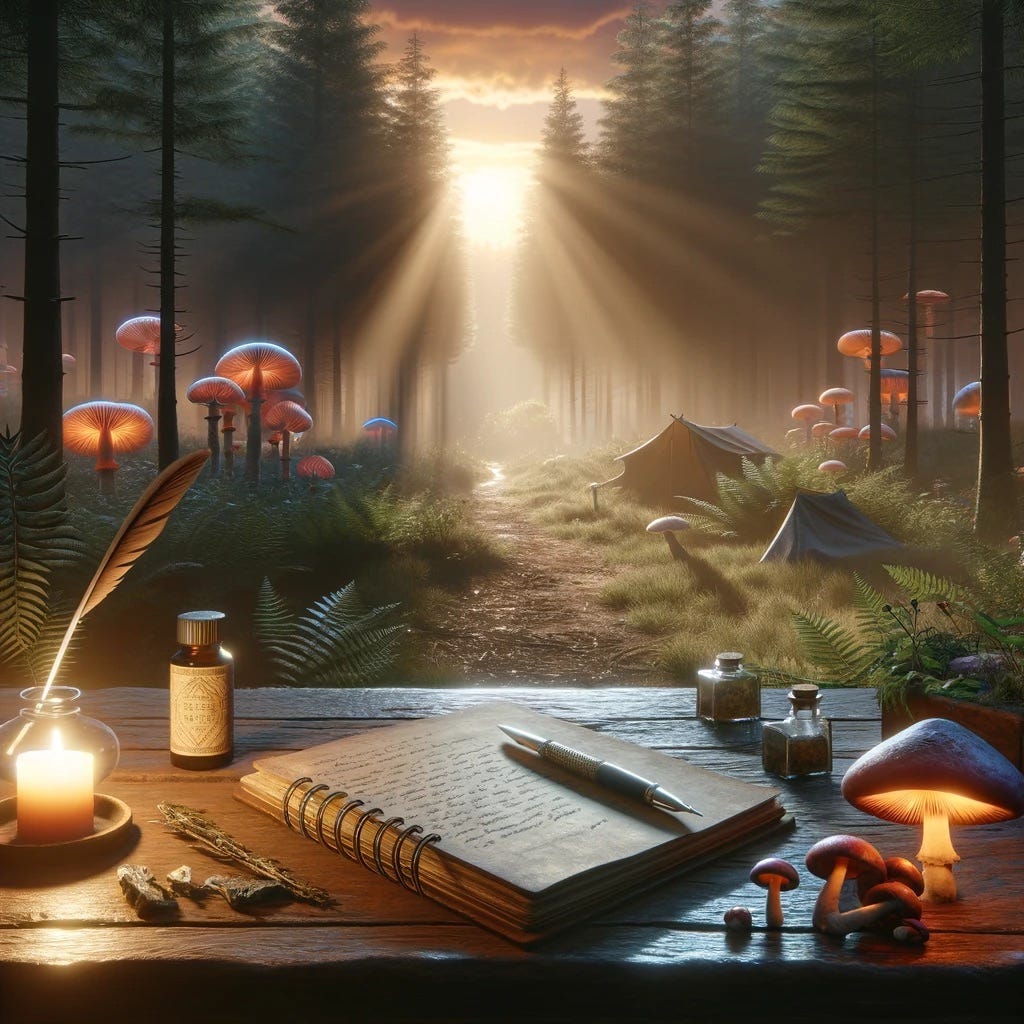
This was exciting. I felt the building momentum of discovery of a realm of life that died for me: mystical spirituality. And not only that, but a spirituality that seemed to have the potential for a higher concentration experience. I could begin to make out the edges of the shape of a spiritual walk that could represent a powerful connection to the earth, to myself, and to mysterious subtle realms. I began to be curious about what psilocybin mushrooms had to offer. Many indigenous tribes treated the mushrooms as their own spiritual entity. What was this doorway that was so ancient that it transcended my nation, civilization and even my religion? Why has it been stigmatized and marginalized?
During a personal retreat, a friend offered me a marijuana gummy, marking my first encounter with THC. Up until that point, my perspective on such substances had already started to shift, and this presented a real chance to explore further. Coming from a background where I'd always been quite cautious, I had never before experimented with marijuana. The experience turned out to be profoundly enjoyable, filled with an evening of deep conversation, laughter, sharing, and reflection.
I started referring to these substances as "plant allies," a term that resonates with the shamanistic view of these natural compounds. Their capacity to facilitate openness and connection among those who approach them with intentionality and care is truly remarkable. In my view, drugs are often synthetic chemicals created in laboratories, like Aleve or ibuprofen, contrasting with plant allies, which I see as natural gifts from the earth. These plant-based helpers can offer gateways to emotional and spiritual dimensions when used with purpose and respect. However, I acknowledge that, like any powerful tool (guns, cars, alcohol), the potential for misuse is always present.
Eager to further explore and experiment within these realms intentionally, I became intrigued by hemp, which had recently become legal in Tennessee. I decided it was time for a solo personal retreat, a form of luxury I hadn't afforded myself in many years. I had acquired 30 mg gel delta 8 hemp capsules and, with deliberate ceremony and mindfulness, I took one. Announcing my intention for growth and personal insight to the universe, I awaited the effects.
As the hemp began to work, I found myself plunged into a deeply emotional state, one that was profound. Experiencing a duality of grief and mourning that lasted for hours, the sensation was at once bewildering, exhausting, and surprisingly refreshing. This experience allowed me to process years of accumulated loss and neglected personal experiences. Confronting deep-seated disappointments over the lack of creative expression in my career and the aspects of myself I was forced to ignore to conform to societal expectations. It was incredibly exhausting and healing.
Experiencing such profound emotional depths was something I hadn't achieved through countless hours of counseling or nearly a year of psychotherapy. Reflecting on this journey, I found myself wondering why I took so long to reach this point of deep personal insight and connection.
After this peak (or was it depth?) experience, default world quickly took back over. I was still running at a pace that was hard to keep up. But I was changed. Even with the demands of career, marriage, and raising the family I felt the subterranean shift of existential ground. Bitten by the desire for an alternate consciousness for a psychedelic experience. Then I had the opportunity to join one.
The opportunity arose from a friend's invitation to an all-night mushroom ceremony, designed to celebrate his journey in life so far and assist him in navigating the emotional aftermath of his recent divorce. It was a unique way of transforming a period of isolation and loneliness into a moment of community and shared experience. He was deeply involved with a group of nature, spirituality, and philosophy enthusiasts in Asheville, NC. This community, having spent years together on bi-monthly nature retreats, had formed a close-knit bond.
As one of the few attendees not part of this immediate circle, I felt a growing anxiety about my place in this unfamiliar setting. To manage this discomfort and satisfy my curiosity, I adopted the persona of an investigative journalist which helped the uncomfortable feeling of foreignness. This approach allowed me to fully engage with the ceremony while maintaining an observant distance, blending participation with the objectivity of an outsider looking in.
Reflecting on the experience, I was struck by a profound insight: the spiritual connection we shared that night bore a remarkable resemblance to the communal worship of my early Christian days, yet it was significantly more intense and focused. The ceremony awakened a deep longing within me for more spiritual and connected communal spiritual expressions and it confirmed my intuition that this energy was very similar to the mystical Christianity I had experienced previously. I was captivated by the genuine energy present, an energy that felt both familiar and impactful, highlighting the potential of human collective experiences in a spiritual context.
This experience resonated with me on multiple levels. It felt like a confirmation of the spiritual truths I encountered in the context of dogmatic Christianity—those moments of shared worship and prayer where a palpable energy is present. Participating in this ceremony offered a different lens through which to view these experiences, suggesting a universal aspect of spiritual connection that transcends specific religious practices. It was as if this night served as an independent validation of the spiritual encounters I had known, affirming the reality of our collective tapping into a profound truth through different means.
Present Reflections from this time
I find myself incredibly grateful for the hunger and curiosity I had in this time of my life. Even with a very full plate I still carved out time to continue to grow and get curious about undiscovered areas of life. Areas that I am very much still unfolding.
The hemp experience felt like ingesting an emotional hand grenade. Many emotions and feelings that were deep seated got dislodged. Tears I didn’t know that needed to flow, flowed. A growing awareness of the narrowed down existence I had pragmatically taken began to take shape. The responsibility of many years of work, family, foster care, and the deconstruction of a deeply held christian belief system all had been unprocessed at an emotional level. And this was the initiatory experience of a deeper journey.
I’ve come to realize how powerful hemp and other plant ally tools can be in my spiritual walk. I now also realize the discovery of these substances over time were originally used in spiritually intentional ways to generate deeper growth. Our civilization has distorted these gifts, both through judgemental labeling policies and through the utilization of them for civilization building (numbing, stimulating, forgetting) instead of sacred purposes, which is dangerous. It seems civilization building has trumped the focus for seeing life and our walk through it as sacred. The sacred walk through life is difficult to see these days in our culture, in part due to the lack of examples and the devaluing of the spiritual. This distortion has led to abuse of coffee, tobacco, alcohol and sugar and other substances from their original purposes of heightening celebrations and spiritual growth. I see how it is easier for some to reject them outright than to know how to artfully use them with intention.
I have intentionally held back the details of the all night ceremony. It was a sacred night that I’ve shared with a few select individuals. It's a mystery that is still unfolding.
Amazing John This is a big help on My Journey thanks for sharing
Wow, love how your story is undulating and circling back around.